
Blog
Why Sri Lankan Food Is Often Mislabelled as Just “Spicy”

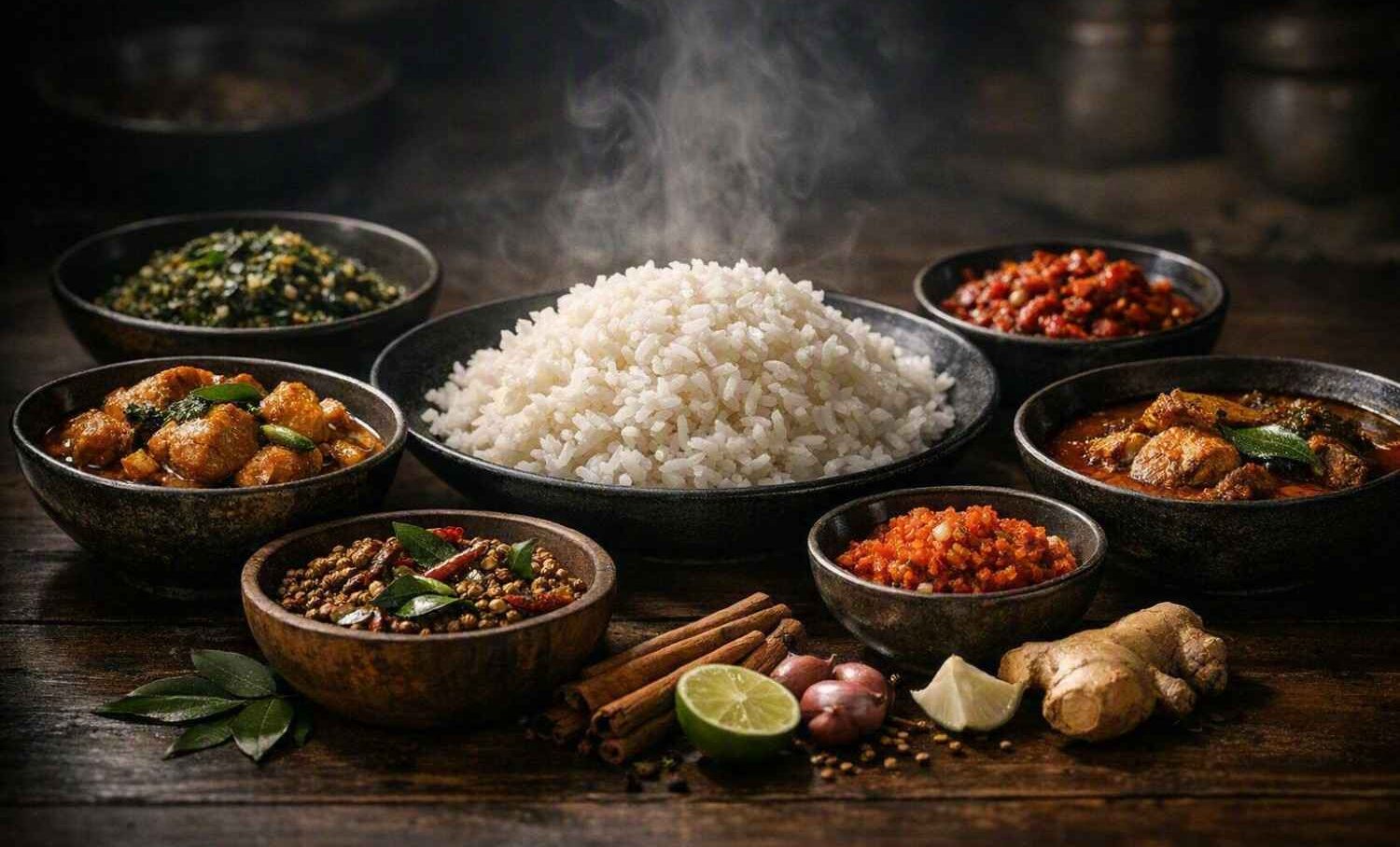
Why Sri Lankan Food Is Often Mislabelled as Just Spicy: A Common First Impression
If you’ve ever introduced Sri Lankan food to someone for the first time, you’ve probably heard the same comment.
“Wow, that’s spicy.”
It usually comes after a meal that included rice, curry, mallung, sambol, and perhaps a rich coconut-based dish.
What’s interesting is that the person may have tasted dozens of flavours during that meal, yet the only thing they mention is the heat.
This perfectly explains why Sri Lankan food is often mislabelled as just spicy.
Heat is the easiest thing to notice. Complexity takes longer to understand.
The truth is that Sri Lankan food is not built around chilli alone. It is built around balance, aroma, roasting, texture, sweetness, acidity, bitterness, and richness. Chilli happens to be one player in a much larger team.
Why Sri Lankan Food Is Often Mislabelled as Just Spicy?
Why Sri Lankan food is often mislabelled as just spicy comes down to perception. Chilli heat is immediate and easy to recognize, while roasted spices, coconut richness, aromatic herbs, acidity, and flavour layering are harder to describe. As a result, many people notice the heat first and miss the complexity underneath.
Sri Lankan Kitchen Real Taste
In a traditional Sri Lankan kitchen, a cook rarely asks whether a curry is spicy enough. Instead, they focus on whether the flavour feels balanced. Too much chilli can ruin a curry just as easily as too little salt. Great Sri Lankan food is about harmony, not heat.
Why Sri Lankan Food Is Often Mislabelled as Just Spicy When Aroma Does Most of the Work
Before flavour reaches the tongue, it reaches the nose.
This is where much of Sri Lankan cooking truly shines.
Think about the smell of:
- Roasted curry powder
- Curry leaves hitting hot oil
- Freshly ground coriander
- Cinnamon and cardamom
- Tempered mustard seeds
These aromas create much of what people actually enjoy in a curry.
The challenge is that aroma is difficult to describe. It is much easier to say “spicy” than to explain twenty different aromatic notes working together.
That is one reason why Sri Lankan food is often mislabelled as just spicy.
Why Sri Lankan Food Is Often Mislabelled as Just Spicy Despite Its Flavour Layers
A good Sri Lankan curry contains multiple flavour dimensions.
In a single mouthful, you may notice:
- Heat from chilli
- Sweetness from onion
- Richness from coconut milk
- Earthiness from turmeric
- Freshness from curry leaves
- Acidity from goraka or tamarind
- Depth from roasted spices
These flavours rarely appear separately.
They work together.
If chilli is the only thing someone notices, it is often because it is the loudest flavour, not because it is the most important.
This explains why Sri Lankan food is often mislabelled as just spicy when it is actually one of the most layered cuisines in the world.
Why Sri Lankan Food Is Often Mislabelled as Just Spicy When Roasting Creates Most of the Depth
One of the defining features of Sri Lankan cooking is roasting.
Many traditional curry powders are carefully roasted before grinding.
This process creates:
- Nutty aromas
- Richer flavours
- Darker colours
- Longer flavour persistence
Roasting often adds more character than extra chilli.
A roasted chicken curry may feel bold and powerful even when the heat level is moderate.
Many people mistake that flavour intensity for spiciness.
In reality, they are experiencing roasting, not just heat.
Why Sri Lankan Food Is Often Mislabelled as Just Spicy When Many Dishes Are Mild
Perhaps the biggest misconception is that every Sri Lankan dish is fiery.
That simply is not true.
Consider dishes such as:
- Kiri Hodi
- Milk Rice
- Coconut Roti
- Many Mallung Varieties
- Tempered Greens
- Certain Lentil Curries
These dishes often focus more on coconut, herbs, texture, and aroma than chilli.
Yet because a few well-known curries are spicy, the entire cuisine gets placed into the same category.
This oversimplification is another reason why Sri Lankan food is often mislabelled as just spicy.
Why Sri Lankan Food Is Often Mislabelled as Just Spicy by Global Food Culture
Globally, cuisines are often reduced to one simple characteristic.
Indian food becomes “curry.”
Japanese food becomes “sushi.”
Italian food becomes “pasta.”
Sri Lankan food often becomes “spicy.”
The problem is not that these descriptions are completely wrong.
The problem is that they are incomplete.
Sri Lankan cuisine deserves to be understood through its flavour logic rather than a single sensation.
Practical Cooking Tips
✅ Roast spices to build flavour before increasing chilli.
✅ Use curry leaves generously for aroma.
✅ Balance heat with coconut milk.
✅ Include acidic ingredients for contrast.
✅ Taste for balance, not just spice level.
Myth vs Fact
Myth: Sri Lankan food is all about chilli.
Fact: Roasting, aroma, coconut, herbs, and acidity are equally important.
Myth: Strong flavour means extreme heat.
Fact: Roasting and spice layering create intensity without excessive chilli.
Myth: Every Sri Lankan dish is spicy.
Fact: Many traditional dishes are mild and aromatic.
Myth: Spiciness and flavour are the same thing.
Fact: Heat is only one part of flavour.
Final Thoughts on Why Sri Lankan Food Is Often Mislabelled as Just Spicy
Understanding why Sri Lankan food is often mislabelled as just spicy requires looking beyond chilli.
The cuisine is built on balance.
Roasted spices create depth.
Coconut creates richness.
Herbs create freshness.
Acidic ingredients create contrast.
Heat provides energy.
Together, these elements create the flavour profile that makes Sri Lankan food unique.
The next time someone describes Sri Lankan food as simply spicy, it may be worth reminding them that what they noticed first was not necessarily what mattered most.
Frequently Asked Questions
Why is Sri Lankan food often mislabelled as just spicy?
Because chilli heat is immediately noticeable, while aroma, roasting, coconut richness, and flavour layering are more difficult to identify and describe.
Is Sri Lankan food only about chilli heat?
No. Traditional Sri Lankan food balances aroma, sweetness, acidity, richness, bitterness, and heat.
What flavours make Sri Lankan food unique?
Roasted spices, coconut milk, curry leaves, cinnamon, tamarind, goraka, and carefully layered seasoning create its unique flavour profile.
Does roasted curry powder create flavour without extra heat?
Yes. Roasting primarily increases depth, aroma, and richness rather than chilli heat.
Why do foreigners think Sri Lankan food is extremely spicy?
Most people notice chilli first because it is the strongest immediate sensation, while the deeper flavour layers take longer to appreciate.
Key Takeaways
✅ Sri Lankan cuisine is far more than chilli heat.
✅ Aroma plays a major role in flavour perception.
✅ Roasted spices create depth and complexity.
✅ Many traditional Sri Lankan dishes are mild.
✅ Balance, not heat, is the foundation of Sri Lankan cooking.
Why Sri Lankan food is often mislabelled as just spicy comes down to perception. Chilli heat is easy to notice, while aroma, roasting, coconut richness, acidity, and flavour layering are harder to describe. In reality, Sri Lankan cuisine is built on balance and complexity rather than heat alone.