
Blog
How Modern Kitchens Changed Traditional Spice Use

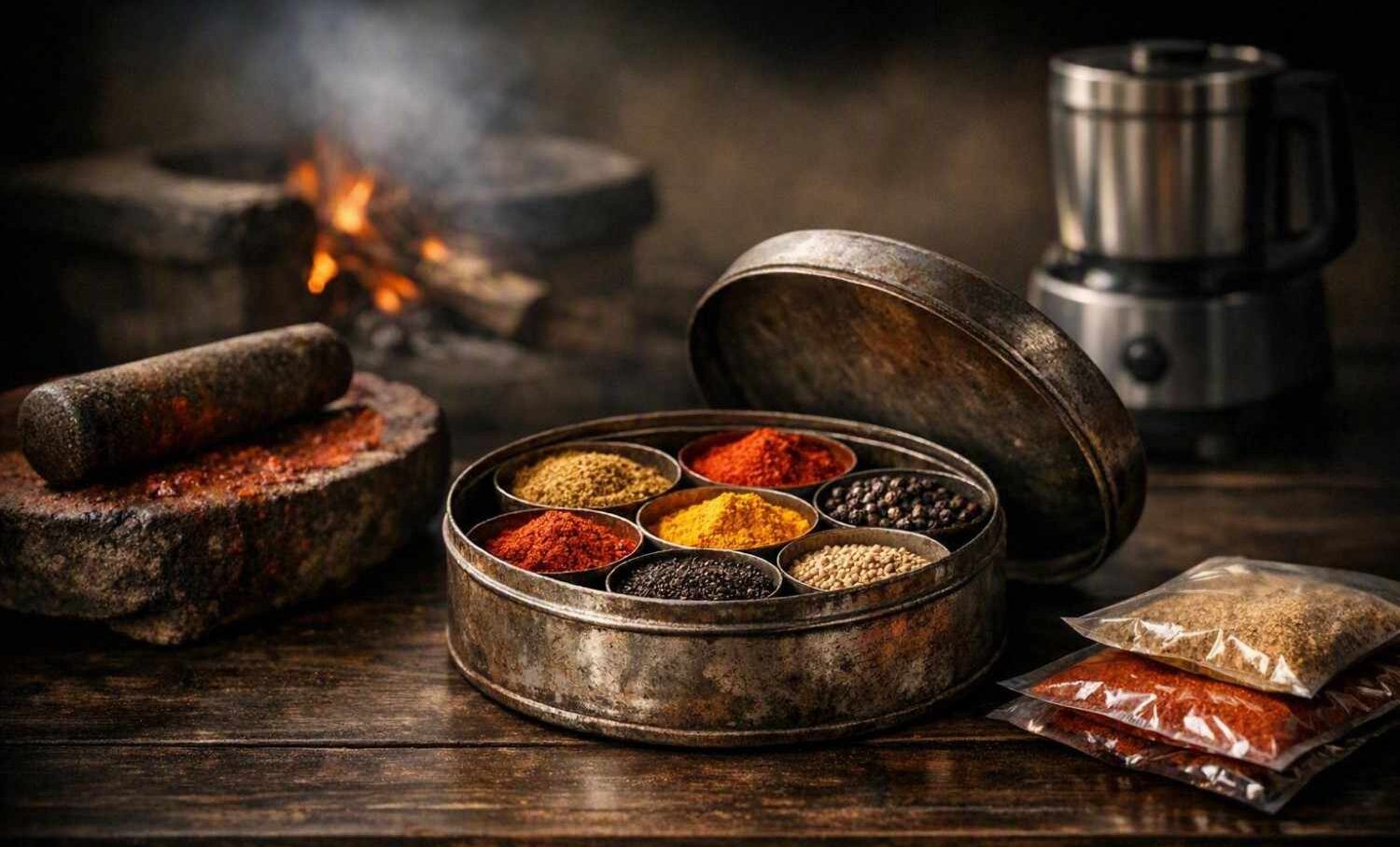
The Curry Powder Tin That Disappeared
There was a time when almost every Sri Lankan kitchen had a spice tin.
Open the lid and you would find the familiar smell of roasted curry powder, chilli powder, turmeric, and pepper. The aromas mixed together, filling the kitchen before a single pot reached the stove.
Nearby sat a miris gala stained red from years of grinding chillies and spices. Outside, a firewood stove slowly heated lunch while smoke drifted through the garden.
Fast forward to today, and the kitchen looks very different.
Spices arrive in sealed packets. A mixer grinder finishes in seconds what once took twenty minutes. Gas burners provide instant heat with the turn of a knob.
The food is still recognisably Sri Lankan.
Yet something about the relationship between cooks and spices has changed along the way.
How Modern Kitchens Changed Traditional Spice Use
How modern kitchens changed traditional spice use can be seen through three major changes: gas replacing firewood, electric grinders replacing stone tools, and sealed spice packs replacing open storage tins. These changes improved convenience, consistency, and food safety, but they also changed how spices release aroma, develop flavour, and interact with everyday cooking.
Sri Lankan Kitchen Real Taste
Older cooks didn’t simply add spices to food. They listened to mustard seeds crackle, smelled coriander as it roasted, and judged curry powder by aroma rather than labels. Modern kitchens may be faster, but the most memorable curries still come from understanding the spices rather than simply using them.
How Modern Kitchens Changed Traditional Spice Use Through Firewood and Gas
One of the biggest transformations happened at the stove.
Firewood cooking was slower and less predictable. The heat rose and fell naturally, forcing cooks to pay close attention. Roasting spices over wood fires often produced deeper aromas and sometimes a subtle smoky character that became part of the dish itself.
Gas changed everything.
Cooking became cleaner, faster, and more controllable. A flame could be adjusted instantly instead of adding wood or waiting for heat to settle.
For busy modern families, this was a major improvement.
However, many older cooks still insist that spices behaved differently over a wood fire. Whether that difference comes from smoke, slower cooking, or memory, it remains part of Sri Lankan food culture.
How Modern Kitchens Changed Traditional Spice Use Through Grinding
Before electric grinders, spices were crushed by hand.
Stone grinding was slow work. It required effort, patience, and experience. But it also created texture.
A hand-ground spice blend was rarely perfectly smooth. Some particles remained coarse. Others became fine. This variation affected how aroma and flavour were released during cooking.
Modern grinders produce results in seconds.
The convenience is undeniable.
Yet high-speed grinding can create heat, and that heat may cause some delicate aromatic compounds to disappear more quickly. The spice blend remains good, but the experience is slightly different.
This is why some cooks still prefer freshly ground spices despite owning modern equipment.
How Modern Kitchens Changed Traditional Spice Use Through Storage
The journey of a spice does not begin when it enters the pan.
It begins when it is stored.
Traditional kitchens often kept spices in open tins, glass jars, or small containers. Because spices were purchased frequently, they were usually used while relatively fresh.
Today, sealed packets dominate supermarket shelves.
This has clear advantages:
- Longer shelf life
- Better hygiene
- Easier transportation
- More consistent quality
But there is a trade-off.
Many people no longer smell, inspect, or interact with their spices as often. The relationship becomes more convenient but less personal.
Spices are still important. They are simply experienced differently.
How Modern Kitchens Changed Traditional Spice Use Through Convenience
Perhaps the biggest change is speed.
Ready-made curry powders, ginger paste, garlic paste, and blended masalas allow people to prepare meals much faster than previous generations.
For modern households, this convenience is often essential.
Yet traditional cooks frequently created spice blends for specific dishes. A fish curry blend might differ from a chicken curry blend. Adjustments were made based on season, ingredients, and personal taste.
Today, many families rely on one or two trusted spice mixes.
Cooking has become simpler.
The challenge is making sure convenience does not replace understanding.
How Modern Kitchens Changed Traditional Spice Use and Cooking Knowledge
Technology changed tools.
It also changed how cooking knowledge is shared.
Many older cooks learned by watching parents and grandparents. Instructions were rarely written down. Skills developed through observation.
Today, recipes come from websites, videos, and social media.
This allows traditional techniques to reach more people than ever before. Yet it can also encourage copying recipes without fully understanding why certain spices are used.
The most successful cooks often combine both approaches.
They embrace modern tools while preserving traditional knowledge.
Practical Cooking Tips
✅ Buy spices in smaller quantities for better freshness.
✅ Roast whole spices whenever possible.
✅ Store spices away from sunlight and moisture.
✅ Grind spices fresh for maximum aroma.
✅ Use modern equipment, but learn traditional techniques.
Myth vs Fact
Myth: Modern kitchens produce less flavourful food.
Fact: Good ingredients and technique matter more than equipment.
Myth: You need firewood for authentic curries.
Fact: Excellent curries can be made on gas stoves.
Myth: Stone grinding is always better.
Fact: Both methods have advantages depending on the dish.
Myth: Ready-made spice blends are poor quality.
Fact: High-quality blends can save time while producing excellent results.
Final Thoughts
When we look at how modern kitchens changed traditional spice use, it is easy to focus on what was lost.
The firewood stove.
The stone grinder.
The familiar spice tin.
Yet modern kitchens also brought important benefits. They made cooking safer, faster, cleaner, and more accessible.
The real lesson is not choosing between old and new.
It is learning from both.
Because whether a spice is stored in a tin or a sealed packet, ground by stone or machine, roasted over wood or gas, its true value still comes from the person cooking with it.
Frequently Asked Questions
Did firewood cooking make spices taste different?
Many cooks believe firewood added subtle smoky notes and slower heat development, which influenced flavour and aroma.
Why were spices traditionally ground using stones?
Stone grinding produced varied particle sizes and released spice oils gradually, creating a unique texture and aroma.
Are sealed spice packets better than spice tins?
Sealed packets protect spices from moisture and contamination, but freshness still depends on storage conditions.
Do electric grinders affect spice aroma?
Fast grinding can create heat, which may reduce some delicate aromatic compounds.
Can modern kitchens still produce traditional Sri Lankan flavours?
Yes. Traditional flavour depends more on ingredients, roasting, and cooking knowledge than on the equipment used.
Key Takeaways
✅ Firewood and gas create different cooking environments.
✅ Grinding methods influence spice texture and aroma.
✅ Storage affects spice freshness and flavour.
✅ Modern kitchens prioritise convenience and consistency.
✅ Traditional spice knowledge remains valuable regardless of technology.
How modern kitchens changed traditional spice use can be seen through the shift from firewood to gas, stones to grinders, and spice tins to sealed packs. While modern kitchens offer convenience and consistency, traditional methods provide valuable lessons about aroma, texture, and flavour that still matter today.